Human in the loop, done properly: approvals people do not rubber-stamp
An approval step protects nothing if the person approving cannot tell a safe change from a dangerous one. What to put in front of them, what never to ask them, and how to stop the gate becoming a habit.
By DevOps.ae. Published 28 November 2026. 5 minute read.
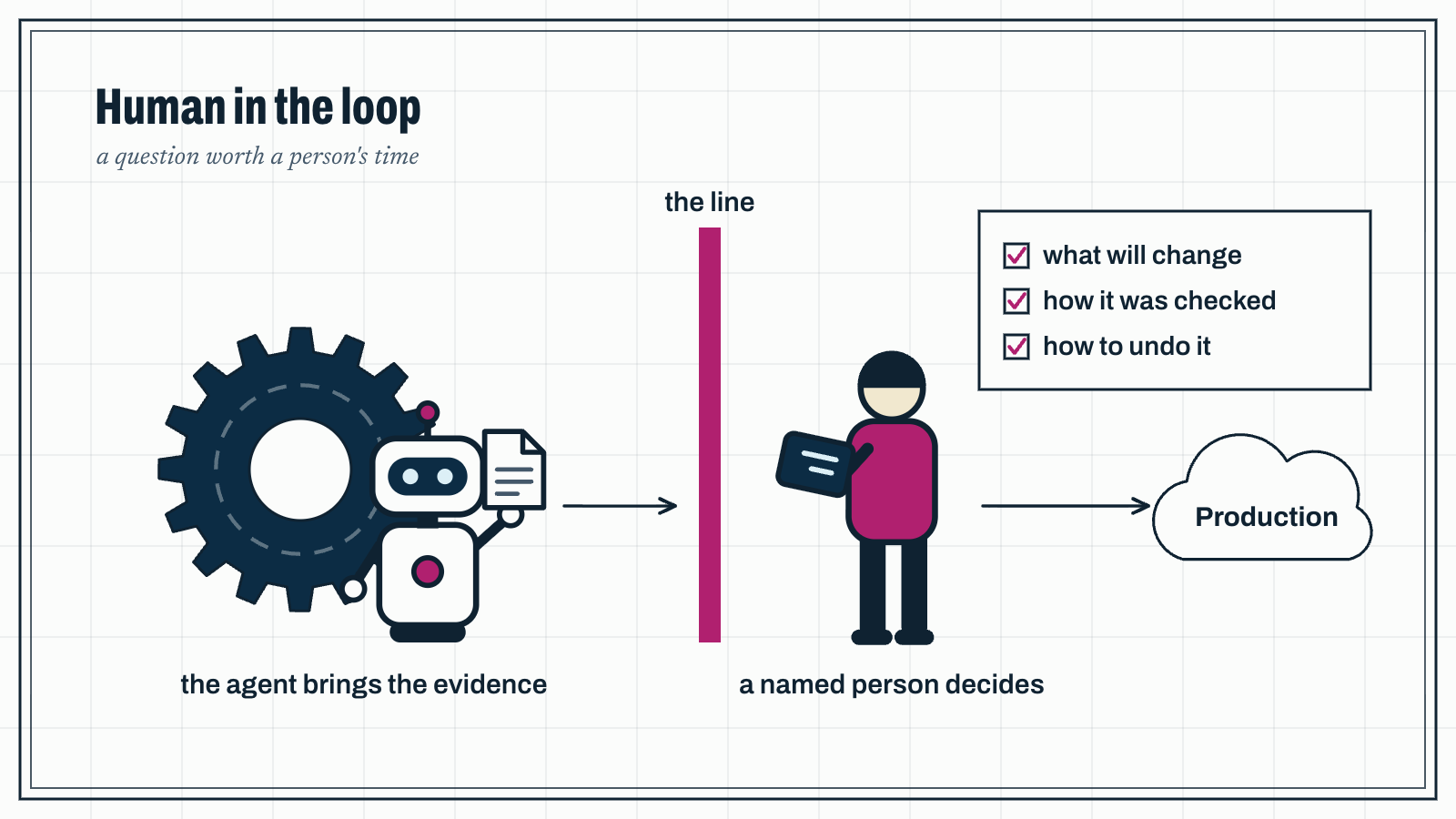
Every sensible plan for AI agents in operations has the same sentence in it: a human stays in the loop. It is the right sentence. It is also where a great many of those plans quietly fail, because nobody decided what the human is supposed to do there.
Picture the usual result. An agent asks for approval forty times a day. Each request is a paragraph of confident text and a button. The engineer on call, who has their own work, learns in a week that the answer is always yes. From then on the gate is a habit, and it will be open on the day it matters.
A person in the loop is only a safeguard if they are able to say no for a good reason. That takes design.
Decide what needs a person
The first job is to ask far less often. A person's attention is the scarcest thing in the system, and every needless request spends some of it.
Two questions sort almost everything:
- Can it be undone, quickly and completely? Restarting a stuck job can. Deleting a database cannot.
- How far does it reach if it is wrong? One test environment, or every customer.
| The action | Undone easily? | Reach | Ask a person? |
|---|---|---|---|
| Comment on a pull request | Yes | None | No |
| Restart a failed job in a test environment | Yes | One team | No: do it, then report |
| Open a pull request with a fix | Yes | None until merged | No: the review is the gate |
| Scale a production service within a range you set | Yes | Customers | No, inside the range. Yes, outside it |
| Apply an infrastructure change to production | Sometimes | Customers | Yes |
| Delete or replace anything that holds data | No | Customers | Yes, always |
| Spend money above a set amount | No | The budget | Yes |
Write this table for your own systems before the agent exists. It is the most valuable page in the design, and it is short.
What the request must contain
When an agent does ask, the request has to let a person decide in about a minute, without opening six other tools. Five things, in this order:
- What will change. The exact resources, by name. "Replace the database instance
orders-prod", not "update the data tier". - Why. One sentence on what the agent was asked to do and what it concluded.
- How it was checked. What it read and ran. A plan that was read in full, tests that passed, a comparison with last week.
- What could go wrong, and how to undo it. If there is no way to undo it, say so in those words.
- What happens if you say no. Sometimes the safest answer is to wait, and the person needs to know what waiting costs.
If the agent cannot fill in the third and fourth, it is not ready to ask. A request that says "I believe this is safe" is a request to share the blame.
Keep it to one screen. A person who has to scroll to find the word "destroy" will, sooner or later, not scroll.
Who is asked
An approval sent to a channel of thirty people is sent to nobody. Each of them assumes one of the others has read it.
Ask one person, by name, who has both the authority to decide and enough knowledge of the system to judge. Where that person changes with the rota, the agent follows the rota.
Two details are easy to miss:
- Silence means no. If nobody answers within the time you set, the agent does not proceed. It tells the next person, and it does not ask the same person eleven times.
- The asker is not the approver. If an engineer set the agent a task, the approval for its riskiest step goes to somebody else, as it would for a change the engineer made by hand.
Keep the gate from becoming a habit
A gate that is always opened is not a gate. Three measures tell you which kind you have:
- How often is the answer no, or "not like that"? If it is never, either the agent is perfect or nobody is reading. Assume the second.
- How long does a decision take? A real judgement on a production change takes more than four seconds.
- How many requests does each person get in a day? Past a handful, quality falls. That is true of people reviewing anything.
When the numbers say the gate has become a habit, there are two honest answers, and both are better than leaving it.
The first is to ask less. If a class of change has been approved two hundred times without a single objection, give it a standing approval with a limit: this kind of change, up to this size, in these environments, reported afterwards. The gate then guards what is left.
The second is to ask better. If people are approving because they cannot tell the difference, the request is not showing them the difference. Fix the request.
Test the gate
Fire alarms get tested. Approval steps should be too.
Now and then, with the team's knowledge that it happens but not when, send a request that ought to be refused: a change that would delete a backup policy, or open a database to the internet. If it is approved, you have learnt something important on a quiet afternoon.
Treat the result as a finding about the system and never about the person. People approve bad changes when the request hides what matters, when there are too many requests, or when saying no is made to feel like getting in the way. Those are all things you can fix.
Keep the record
Every decision is written down with what was asked, what evidence was shown, who decided, and when. It takes no effort if the request and the answer live in the tools you already use, such as the pull request or the change ticket.
The record does two jobs. An auditor can see that the control exists and works. And when something does go wrong, the review can start from what the person was shown, which is nearly always where the real fault lies.
The short version
- Ask a person only about what cannot be undone or reaches far.
- Put the change, the evidence and the way back on one screen.
- Ask one named person, and treat silence as no.
- Measure whether anyone ever says no.
- Test the gate before you need it.
This is the first of the rules every one of our agents runs under. For how the rest of an agent's work is arranged around the gate, see what changes when you hand over the job.