Agentic DevOps: what changes when you hand over the job, not the steps
A pipeline runs the steps you wrote. An agent is given the job and works out the steps. What that changes in delivery and operations, what it leaves alone, and how to tell the real thing from a chatbot with a new name.
By DevOps.ae. Published 28 November 2026. 6 minute read.
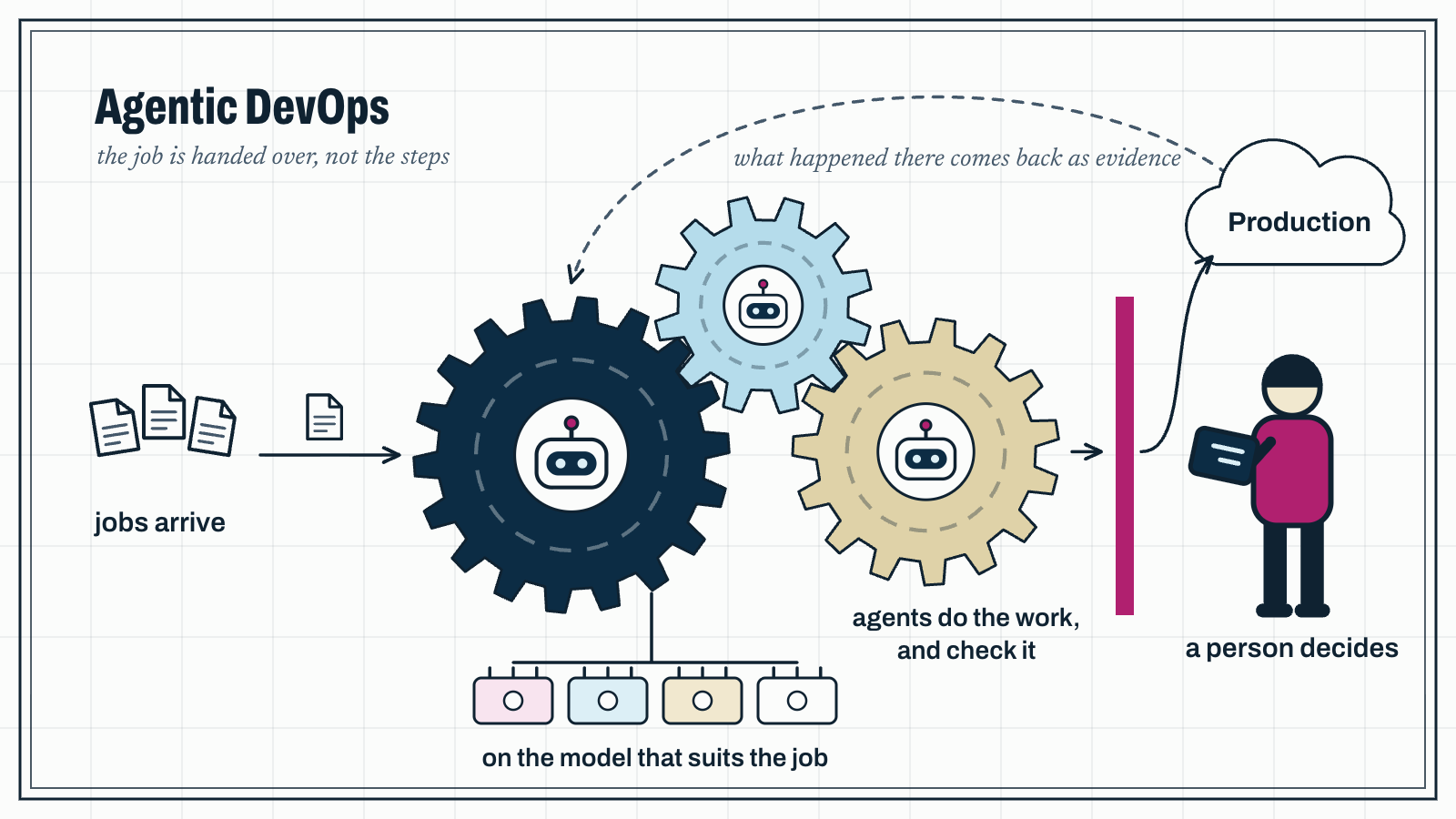
DevOps has spent more than fifteen years turning work into steps a machine can repeat. A pipeline is the result: build, test, scan, deploy, in that order, every time. It is one of the best ideas the industry has had, and it has a limit. A pipeline does exactly what it was told. When something happens that nobody wrote a step for, it stops and waits for a person.
Agentic DevOps starts from the other end. You do not give the machine the steps. You give it the job, the tools and the limits, and it works out the steps for itself.
Automation and agents are different tools
It is tempting to see an agent as a cleverer script. It is better to see the two as tools for different kinds of work.
| The question | A pipeline or script | An agent |
|---|---|---|
| What you write | Every step, in order | The job, the tools it may use, and what it may never do |
| What it handles | The cases you thought of | Cases you did not, within its limits |
| When it meets something new | It fails and stops | It reads, tries, checks and reports |
| How it goes wrong | Loudly, at a known step | Quietly, with a confident wrong answer |
| Best for | Work that must be the same every time | Work that needs reading and judgement |
The last two rows matter most. A deploy should be the same every time, so a deploy stays a pipeline. Working out why last night's deploy was slow is different every time, so that is work for an agent. And because an agent can be wrong without failing, everything it does needs a check that does not depend on its own word.
What the loop looks like
An agent's work has a shape, whatever the job:
- Read. The change, the logs, the plan, the runbook. All of it, not the summary.
- Act, where it is safe. Run the plan. Run the tests. Query the metrics. Nothing that changes production.
- Check. Compare what it found with what it expected. If they disagree, go round again.
- Report. Say what it found, with the evidence, in the place the team already looks.
- Stop. Where the next step cannot be undone, hand the decision to a person.
In delivery, that might be an agent that reads every infrastructure change and says what it would destroy. In operations, it might be one that gathers the evidence on an alert while the engineer is still opening a laptop. The picture at the top of this page is that loop drawn as a machine: the gears turn the job over between them, and the line before production stays shut until a person opens it.
Four stages of handing over
Nobody should go from "no agents" to "agents run production". There are four stages, and each has to be earned.
- It reads. The agent has read-only access and writes comments. If it is wrong, nothing happens. Start here.
- It proposes. It opens pull requests and drafts changes. A person merges. The agent's work is now judged by how much of it survives review.
- It acts with approval. It can carry out a change, but only after a named person has said yes to that change.
- It acts within limits. For a narrow class of reversible things (restarting a stuck job in a test environment, scaling within a range you set) it acts first and reports after.
The way to move up a stage is evidence. Keep a count of how often the agent's conclusion matched what your engineers concluded. When that has been high for long enough that you would trust a new colleague with the same record, move one stage, for that one job. Most work never needs to reach the fourth stage, and that is fine.
What does not change
A good deal of DevOps exists to make change safe, and none of that is retired.
- Version control is still the source of truth. An agent's change is a commit like any other, with an author and a review.
- Tests still decide. An agent that says a change is safe is offering an opinion. A passing test suite is evidence.
- Least privilege matters more. An agent gets its own identity and only the access its job needs. Not a copy of an administrator's.
- A person is still accountable. "The agent did it" is not an answer in an incident review. Every agent has an owner, by name.
If your delivery process is not in good order, agents will not put it in order. They will work faster inside the disorder.
What changes for engineers
The work moves from doing to directing, which is a real change of skill.
Writing the job down. An agent works from a description of the job and its limits. Teams that already have clear runbooks find this easy. Teams whose knowledge lives in three people's heads have to write it down first, which was worth doing anyway.
Designing access. Most of the safety of an agent is in what it is able to touch, not in what it is told. Working out the smallest set of permissions for a job is engineering, and it is the part to spend time on.
Building the test cases. Each agent needs a set of real cases with known right answers: last quarter's incidents, a handful of changes that were dangerous and a handful that were not. Without them you cannot tell whether a new prompt, or a new model, made it better or worse.
Reviewing evidence, not output. The useful question about an agent's report is not "does this read well?" but "what did it look at?". A report that shows its evidence can be checked in a minute.
How to tell the real thing
Much of what is sold as agentic is a chat window beside a dashboard. Five questions separate the two, and they are worth asking of your own work as well as a supplier's.
- What can it touch, exactly, and who granted each permission?
- What does it do when it is not sure?
- Where is the record of what it did and why?
- What was it tested against before it was allowed near your systems?
- What does one piece of work cost, and what happens when the budget runs out?
A clear answer to all five is a system you can run. A vague one is a demonstration.
Where to start
Pick one job that is repetitive, well understood and harmless to get wrong while you are watching. Change review is the usual choice, because the agent only reads and comments. Run it beside your engineers for a few weeks and compare. Then decide, on the evidence, whether it has earned a second job.
That is the approach behind GAAS, our agents run as a service. If you would like to go further into the parts of this, we have written about what an agent can safely do in platform work, splitting the work between several agents, approvals that mean something and staying free to change model.