What an AI agent can do in platform work, and where a person decides
An agent is a model with tools, a job and limits. Which DevOps work suits one, which does not, and the rules that make it safe to let one near your infrastructure.
By DevOps.ae. Published 28 November 2026. 4 minute read.
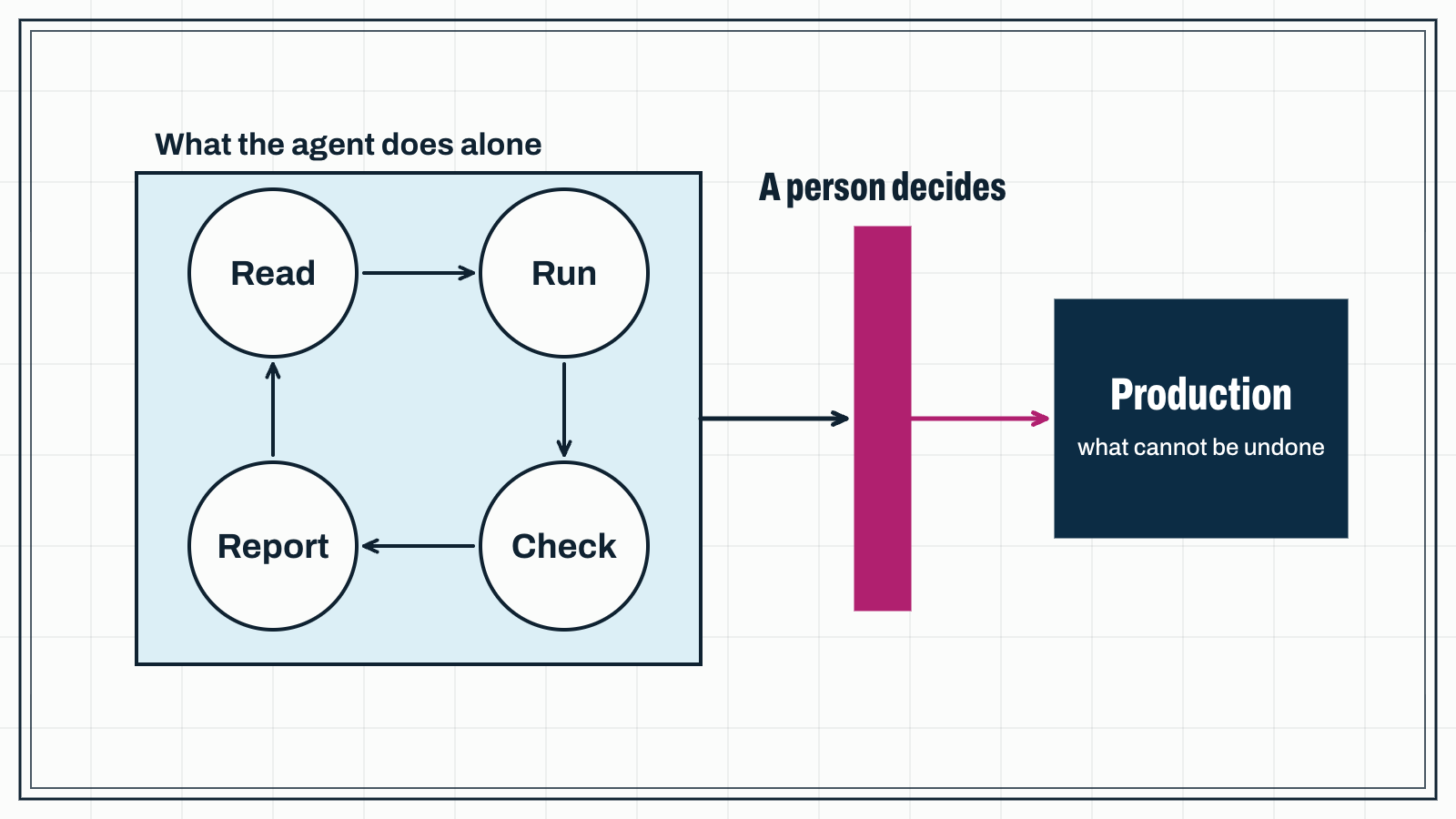
Most teams have met AI as a chat window: you ask, it answers, you copy the answer somewhere. An agent is a different thing, and the difference matters more in operations than anywhere else.
An agent is a language model that has been given three things: a job, a set of tools, and a set of limits. The job might be "review this infrastructure change". The tools might be reading a repository, running a plan, and posting a comment. The limits say what it may never do. Given those, it works the way an engineer does. It reads, it runs something, it looks at the result, it decides what to check next, and it writes up what it found.
Nobody has to prompt it step by step. That is the useful part, and it is also why the limits have to be right.
Work that suits an agent
Agents are good at work with a lot of reading, a clear way to check the result, and no need to make an irreversible decision.
Reviewing changes. An infrastructure plan can run to a thousand lines. People read the summary at the bottom. An agent reads all of it and says, in plain words, what would be created, what would be replaced, and what would be destroyed. Here is one from our own infrastructure, a plan for a new platform:
46 to add, 0 to change, 0 to destroy. Everything is new and carries this project's name. Nothing that already exists is touched.
That sentence is only worth having because the whole plan was read to produce it.
Investigating. When an alert fires, the first twenty minutes go on gathering: what was deployed, what the logs say, whether this has happened before. An agent does that gathering in a minute or two and hands a person the timeline, so the person starts at the interesting part.
Measuring instead of assuming. A well-run agent checks its own conclusion. Suppose pages are loading slowly from one office. The obvious suspect is the new server. The useful test is to fetch the same amount of data, at the same moment, from somewhere else on the same route. If that stalls too, the server is not the problem. An agent will run that comparison every time, because it costs it nothing.
Routine maintenance. Dependency updates, base image updates, version bumps. The work is repetitive, the tests say whether it worked, and nobody wants to do it.
Collecting evidence. Who has access, what changed last month, which controls ran. An auditor asks for it once a year and it takes a week to assemble by hand.
Work that does not
Anything that cannot be undone. Deleting data, replacing a database, deploying to production, spending money. An agent can prepare all of these. A person should approve each one.
Work nobody can check. If there is no test, no plan output and no second measurement, you cannot tell a right answer from a confident wrong one. Models are fluent when they are wrong.
Decisions someone has to answer for. Whether to accept a risk, whether to move a release. The agent can lay out the evidence. The decision belongs to a person with a name.
Six rules
These are the rules we run every agent under. They are short on purpose.
- It asks before anything that cannot be undone. The agent prepares the change and shows its evidence. A named person approves.
- It has its own identity and the least access that works. Read-only by default. Never a person's credentials, and never an administrator's.
- Everything it does is on the record. Every command, every file read, and the reasoning it gave, kept where the team can search it.
- It is tested before it is changed. Keep a set of real cases with known right answers. A new prompt, tool or model has to pass them first.
- Its spending has a ceiling. A budget per task. When it is spent, the agent stops and says so.
- Secrets stay out of its sight. It should be able to use a credential without being able to read it, and nothing secret belongs in a prompt or a log.
None of these is new. They are the rules for a new engineer on their first day, written down because an agent will not pick them up by watching.
What goes wrong
It sounds certain. An agent that has not checked something will often describe it as though it had. Ask it to show the command and the output. If it cannot, it does not know.
Its knowledge has a date. A model learned what it knows up to some point in the past. Regions open, tools change, prices move. For anything that could have changed, it should look it up from the source, not answer from memory.
It does more than it was asked. Given a small job and broad access, an agent may tidy things nobody mentioned. Narrow access is the cure: it cannot change what it cannot reach.
It hides nothing, which you have to read. An agent's record of its own work is long. Somebody has to actually look at it, at least at first, or the record protects nobody.
Where to start
Start with change review. The agent only reads and comments, so the worst it can do is waste a reviewer's minute. Run it beside your engineers for a few weeks and compare what it says with what they say.
If it catches what they catch, and now and then something they missed, give it a second job. If it does not, you have lost very little and learned where it falls short.
That is the whole method: one agent, one job, measured against people who know the work. It is how we work in Agentic as a Service.